
No One Says, “My Favorite Music Is AI Music.”

People connect with artists, songs, genres, and moments. Production methods rarely become part of that bond.
No one says, “My favorite music is AI music.”
People say they love jazz, hip-hop, punk, country, or bands like the Grateful Dead, Led Zeppelin, or an up-and-coming group that blew them away. They name a show that changed their life, an album they played throughout high school, or a song that reminds them of a particular person.
That may be the central challenge facing AI-generated music.
AI can now produce remarkably convincing songs in almost any style. It can imitate the sound of a particular era, combine genres to create a new vibe, and generate more music in a day than any person could hear in a lifetime.
But technical capability only gets a song so far.
We use music to understand ourselves, find our people, remember particular moments, and connect with the artists who created it. AI can reproduce many of the characteristics of music. Creating a reason for people to care presents a much harder challenge.
AI describes the process, not the music
The term “AI-generated” tells us how something was made. It says very little about what the music sounds like, what it represents, or who might love it.
Synthesizers, drum machines, sampling, Auto-Tune, and digital recording through Pro Tools all changed the sound and economics of music. Some of those technologies helped create entirely new genres and creative movements. Their cultural value came from the artists who found expressive ways to use them.
AI may follow a similar path.
Musicians will use it to explore ideas, manipulate sound, accelerate production, and create things that would otherwise be impossible. Eventually, much of the technology may become invisible to the listener.
That does not mean listeners will stop caring about who made the music or why it exists.
Generating music is easier than generating interest
Fully synthetic music is arriving at an extraordinary scale.
Deezer reported that the share of its daily deliveries identified as fully AI-generated rose from roughly 10 percent in January 2025 to more than 50 percent at its peak in June 2026. At that point, the platform was receiving approximately 90,000 AI-generated tracks every day.
Demand tells a different story.
Fully AI-generated tracks accounted for only 1 to 3 percent of total streams on Deezer. The company also reported that up to 85 percent of streams on those tracks were fraudulent in 2025 and were demonetized.
Those figures reflect one platform and its particular policies. Even so, the gap is striking.
Generating more music has proven far easier than generating genuine interest in it.
Hearing the difference may not be the point
A 2025 international study commissioned by Deezer and conducted by Ipsos presented listeners with two fully AI-generated songs and one human-made recording.
Ninety-seven percent of respondents failed to identify all three correctly.
That sounds like a decisive victory for generative AI. If listeners cannot reliably hear the difference, the technology has clearly crossed an important threshold.

The rest of the survey reveals a more complicated reaction.
Eighty percent of respondents wanted fully AI-generated music labeled. Seventy-three percent of streaming users wanted to know when a service was recommending it. More than half felt uncomfortable after learning they could not reliably distinguish it from human-made music.
The audio passed a technical test. The relationship with the listener remained unsettled.
Listeners are also curious. Sixty-six percent of streaming users said they would listen to fully AI-generated music at least once.
Curiosity can produce a click. Fandom requires attachment, loyalty, identity, and a desire to hear what an artist does next.
That attachment lasts far longer than the dopamine rush of tapping on a screen.
We connect with the people behind the songs
I see this from two sides.
As CEO of Feed.fm, I work with technology that helps digital products deliver licensed music to listeners. As a musician with Fuzz Collective, I experience what happens when people make music together and perform it in a room full of other people.
At a Fuzz Collective show, the musicians respond to one another in real time. A solo develops differently from the previous performance. Someone plays an unexpected phrase, another musician reacts, and the direction of the song changes.
The band also responds to the room. The audience’s energy affects how we play, and the performance becomes something created by everyone who is there.
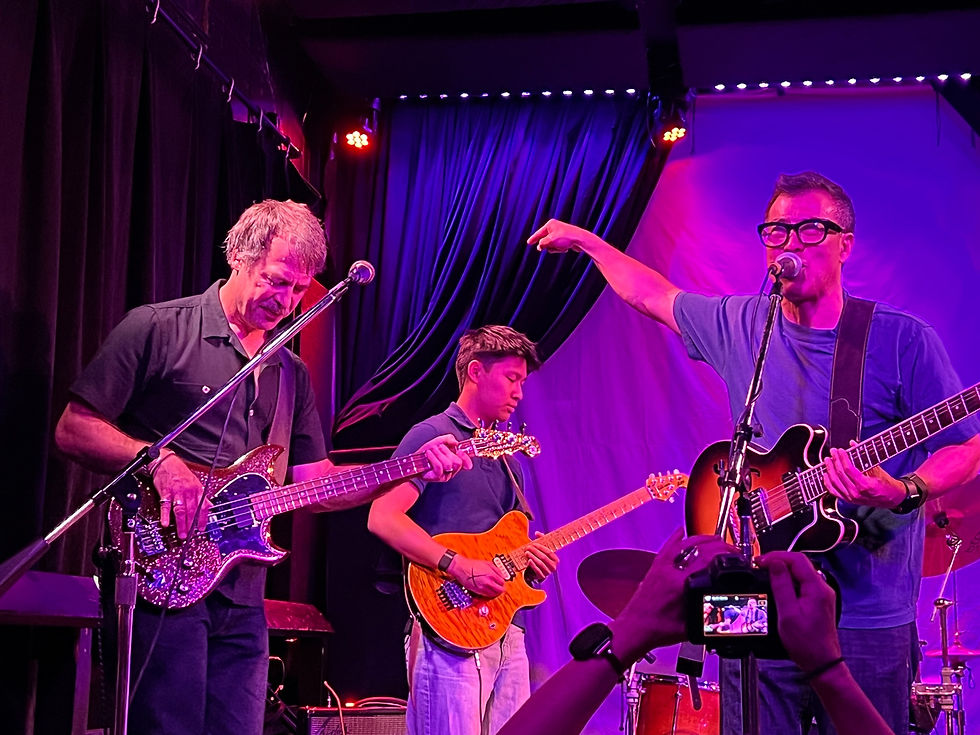
That experience cannot be reduced to the acoustic properties of a recording.
Music carries the people, relationships, history, and intention behind it. Those things influence how we hear a song, even when they cannot be detected in the audio itself.
Research supports that intuition. In IFPI’s study of more than 43,000 people across 26 countries, 79 percent said human creativity is essential to the creation of music. Seventy-six percent said an artist’s music or vocals should require permission before being used by AI, and 74 percent opposed unauthorized AI cloning or impersonation.

Listeners do not care only about whether a song sounds good. They also care about the story behind the sound and the choices that brought it into existence.
Music helps us tell stories about ourselves
Ask someone about a favorite song, and the answer often turns into a personal story.
It may involve the friend who introduced them to a band, the concert where they met their partner, a song their parents played, or the album that helped them through a difficult year.
For me, I remember listening to Miles Davis’ “Someday My Prince Will Come” hundreds of times during a rough patch in my early professional career in the ’90s.
Music becomes attached to memory because it accompanies real life. It also helps us signal identity and find people who recognize the same signals.
I remember how people sat in different parts of the school cafeteria based on the music they liked. Long before an algorithm classified anyone by listening behavior, music was helping us find our people.
IFPI found that fans worldwide listen to more than eight genres on average. Seventy-one percent consider music important to their mental health, while 78 percent say it helps them relax and cope with stress.
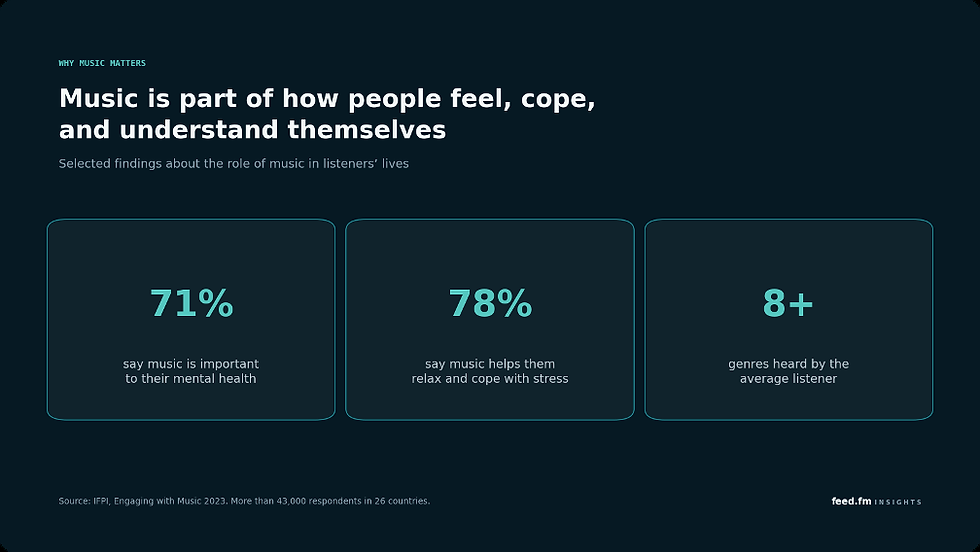
Feed.fm’s Music for Wellness report, developed in consultation with Stanford neuroscientist Dr. Dan Bowling, explains that music can bring people together by synchronizing movement and emotion and increasing feelings of connection.
That captures something a streaming statistic cannot. Music affects us individually while also connecting us to other people.
An AI system can generate a plausible soundtrack for an emotion. Human experience gives that soundtrack meaning.
Musicians will make music with AI
The boundary between human and machine-made music will become increasingly difficult to draw.
A single recording might involve a human songwriter, an AI-assisted arrangement, generated sound design, a live vocalist, algorithmic mixing tools, and a producer making the final creative decisions.
A simple “human” or “AI” label may tell us very little about the creative process.
The more meaningful question is how AI participates in that process.
Artists can use AI deliberately and transparently to expand their creative possibilities. Other systems can produce anonymous imitations at industrial scale. Both approaches may produce technically convincing recordings, but their cultural value will depend on the context surrounding the music and the connections they develop with listeners.
A human artist may use AI to express something deeply personal. A community may embrace a synthetic performer and build a genuine culture around it. Listeners may attach memories to a song without knowing or caring exactly how it was produced.
Technology does not automatically remove meaning from music. It also cannot create that meaning by itself.
Why we make music
Technology will keep changing how music is written, recorded, mixed, distributed, and discovered. It always has.
But the reason we make music has not changed.
We make it to express something. We make it to connect with other people. We make it because playing together can create something none of us would have created alone.
And, if we are fortunate, we make a song or a performance that becomes part of someone else’s story.
That is what we are trying to do with Fuzz Collective.
AI can help create music. It can help us find it and place it in the right moment.
For music to matter, someone still has to give us a reason to care.
Follow Fuzz Collective on Instagram for new music, videos, and upcoming performances.


Comments